⚠ Three rules before you wire anything.
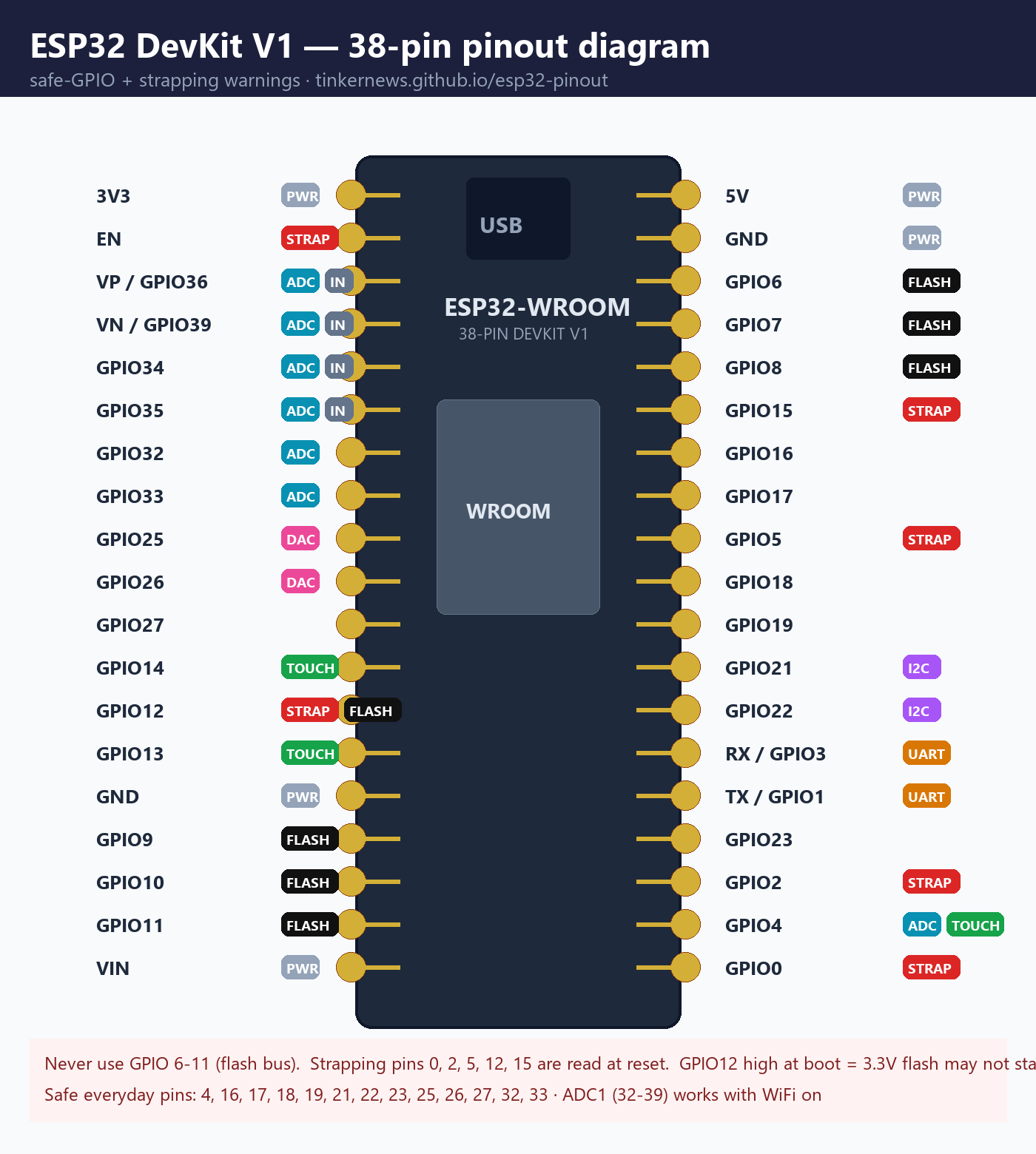
1. Never use GPIO 6–11 — they connect the ESP32 to its flash chip. Using them crashes the board.
2. Strapping pins (0, 2, 5, 12, 15) are read at reset: they set boot mode and flash voltage. External pulls on these can stop the board booting.
3. GPIO 12 pulled high at boot = 3.3V flash modules may not start. Leave it floating unless you know your flash voltage.
1. Never use GPIO 6–11 — they connect the ESP32 to its flash chip. Using them crashes the board.
2. Strapping pins (0, 2, 5, 12, 15) are read at reset: they set boot mode and flash voltage. External pulls on these can stop the board booting.
3. GPIO 12 pulled high at boot = 3.3V flash modules may not start. Leave it floating unless you know your flash voltage.
✅ Safe general-purpose pins: GPIO 4, 16, 17, 18, 19, 21, 22, 23, 25, 26, 27, 32, 33.
Need analog with WiFi on? Use ADC1 (GPIO 32–39) — ADC2 conflicts with WiFi.
Pin reference
Quick matrices
| Function | Pins |
|---|---|
| ADC1 (WiFi-safe) | GPIO 32 (VP), 33 (VN), 34, 35, 36 (SVP), 39 (SVN) |
| ADC2 (conflicts with WiFi) | GPIO 0, 2, 4, 12, 13, 14, 15, 25, 26, 27 |
| Touch | GPIO 4, 0, 2, 15, 13, 12, 14, 27, 33, 32 |
| PWM (LEDC, all outputs) | GPIO 0–23, 25–27, 32–33 (not 34–39: input-only) |
| Input-only pins | GPIO 34, 35, 36, 39 (no pull-ups, no output) |
| I²C defaults (Wire) | SDA = GPIO 21, SCL = GPIO 22 (any output pin can be remapped) |
| Hardware SPI (VSPI) | SCK = 18, MISO = 19, MOSI = 23, SS = 5 |
| UART0 (USB serial) | TX = GPIO 1, RX = GPIO 3 |
| Output-only (3.3V logic) | GPIO 34–39 are input-only; all others drive up to ~12mA safely |
FAQ
Which pins are safe at boot?
GPIO 0, 2, 5, 12, 15 are strapping pins read during reset. GPIO 6–11 belong to flash. The safe everyday set: 4, 16, 17, 18, 19, 21, 22, 23, 25, 26, 27, 32, 33.
Why does ADC2 stop working with WiFi?
The WiFi radio shares the ADC2 SAR. Use ADC1 (GPIO 32–39) for analog reads on connected projects.
Can GPIO 34–39 use internal pull-ups?
No — the input-only pins lack internal pull resistors. Add external ones (10kΩ typical).
Like these tools? They come out of TinkerNews, a free weekly issue of the best DIY electronics builds. One email, every Sunday.