—
Pick colors above.
Printable color chart
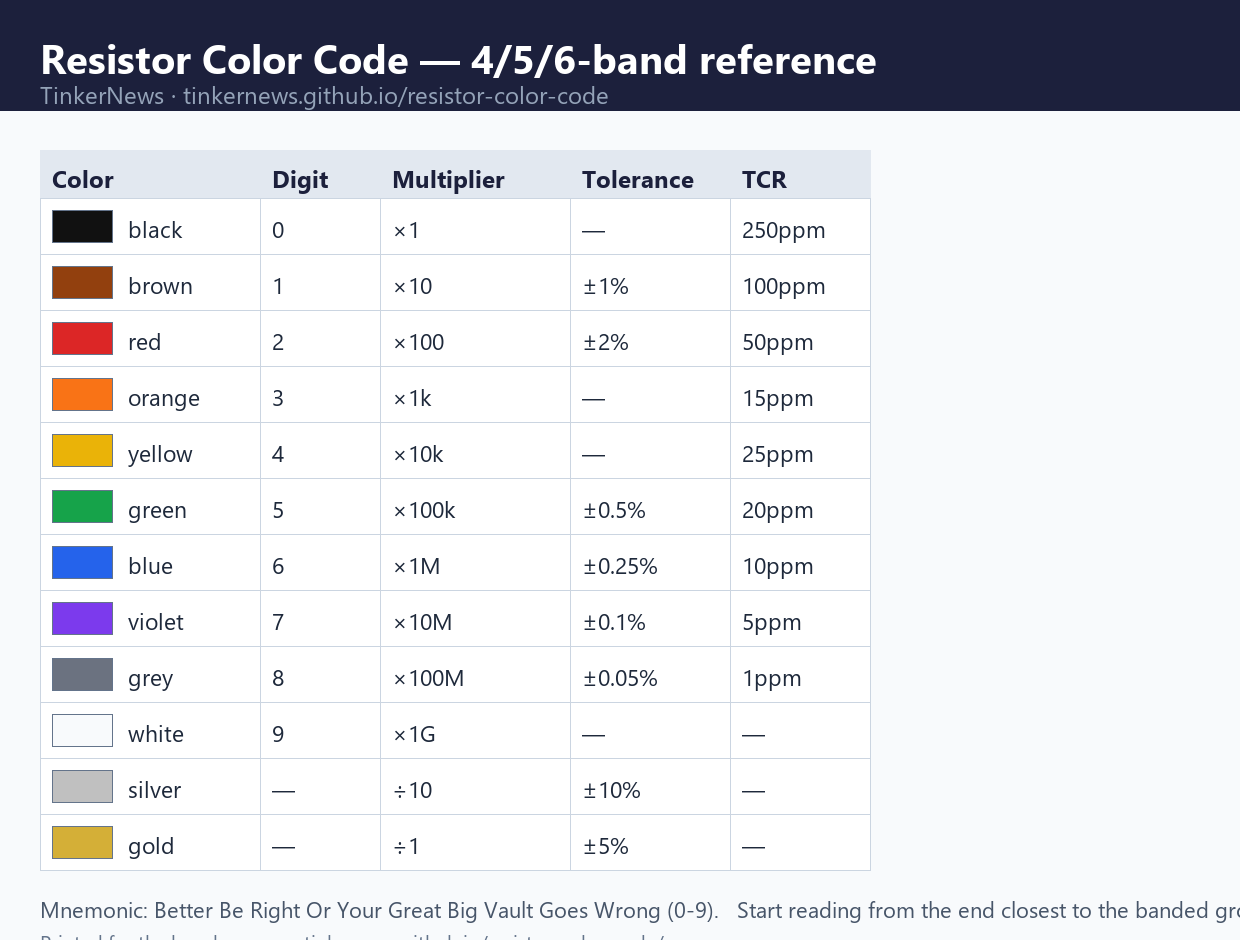
Mnemonic
Better Be Right Or Your Great Big Vault Goes Wrong — Black Brown Red Orange Yellow Green Blue Violet Grey White = 0 through 9.
Worked examples
| Bands | Reading | Result |
|---|---|---|
| Red Brown Black Gold (4) | 2-1 ×10⁰ ±5% | 21 Ω ±5% (19.95–22.05 Ω) → E12: 22 Ω |
| Brown Black Orange Gold (4) | 1-0 ×10³ ±5% | 10 kΩ ±5% → E12: 10 kΩ |
| Yellow Violet Red Silver (4) | 4-7 ×10² ±10% | 4.7 kΩ ±10% → E12: 4.7 kΩ |
| Brown Black Black Brown Brown (5) | 1-0-0 ×10¹ ±1% | 1.00 kΩ ±1% → E96: 1 kΩ |
| Orange Orange Black Black Red (6) | 3-3-0 ×10⁰ ±2% +TCR 50ppm | 33 Ω ±2%, 50 ppm/°C |
FAQ
What do 4 red-brown-black-gold bands mean?
Red=2, brown=1, black=0 → 21 × 10⁰ = 21 Ω, gold = ±5% → 19.95–22.05 Ω. Nearest E12 value: 22 Ω.
Which side is the tolerance band?
The lone band at one end — usually gold or silver, slightly separated. Read from the end closest to the banded group.
How do I read a 5-band resistor?
Three digit bands (d1 d2 d3) then multiplier, then tolerance: 1-0-0 ×10¹ = 1000 Ω. 5-band values are typically 1%-tolerance metal film.
Like these tools? They come out of TinkerNews, a free weekly issue of the best DIY electronics builds. One email, every Sunday.